The picturesque Semiahmoo Resort is nestled in a wonderland of nature and outdoor adventure near the U.S.-Canada border in the Pacific Northwest. It was constructed in the 1970s and, according to Laura Moorhead, president of Seattle-based Blue Sky Integrated Technologies, was due for an AV makeover when new owners purchased it a few years ago. “They wanted to upgrade numerous elements of the resort and AV was one of them. The old system had been there for decades,” said Laura, who was hired to perform the upgrade.
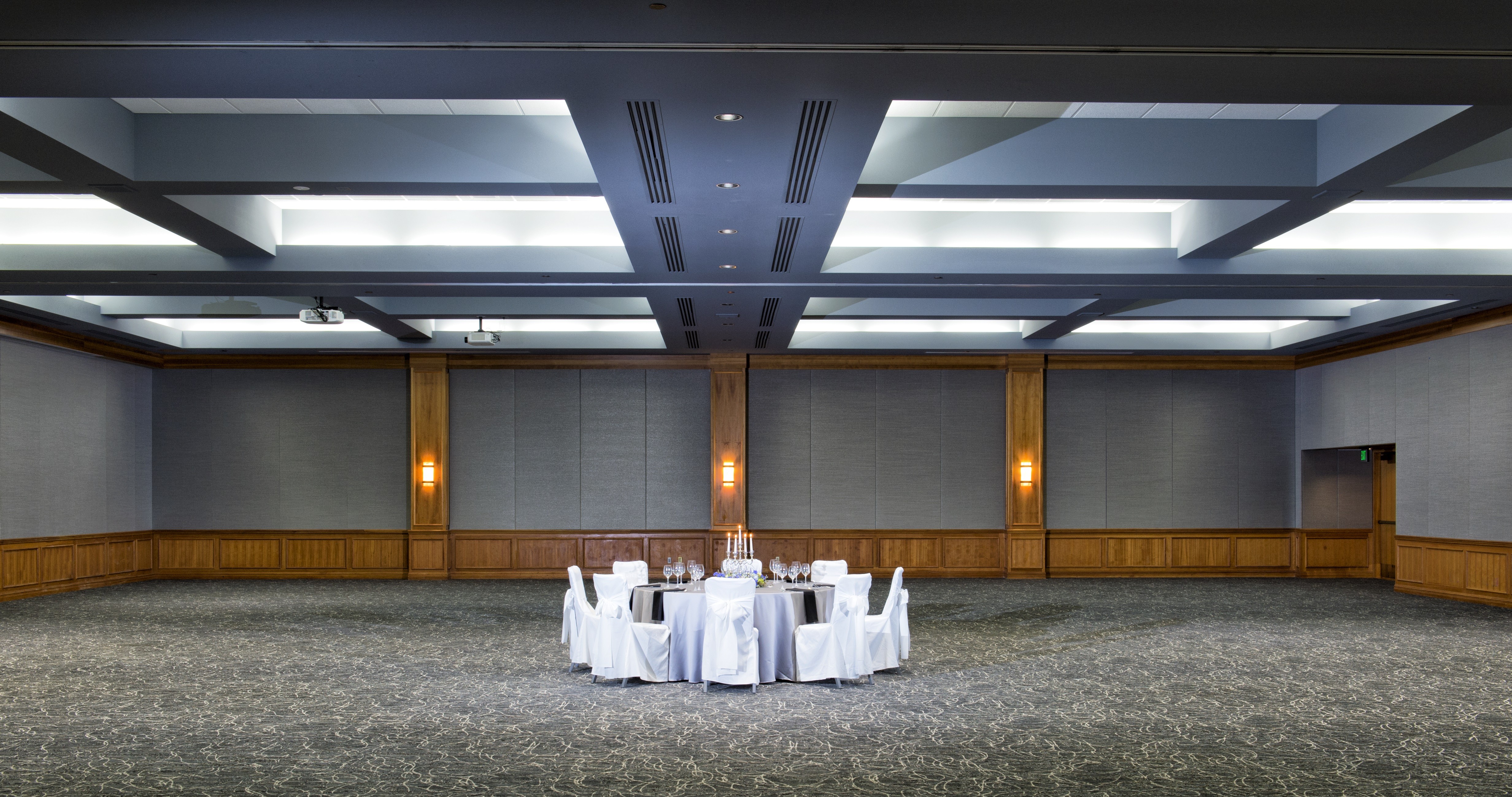
A focal point of the resort is a 6,510 square-foot, three-way divided ballroom with towering ceilings. It’s a popular place for weddings, but with so many high-tech companies and software developers only a few hours away in Seattle, the new owners also wanted to attract corporate clients for retreats and two-day meetings.
“The resort had never installed motorized projection screens or anything like that before; nearly everything had to be done manually,” said Laura. “Back in the 70s, there may have been overhead projectors, but not the sophisticated display systems we have now. They did have built-in audio and audio combining, which could link the three rooms or divide them, as needed. There were microphone input plates throughout the ballroom, which were tied to an audio processor, but that was the only built-in technology they had.”
One of the new owner’s priorities was to install motorized projection screens, but not necessarily have dedicated projectors for each of them. “The general contractor installed seven motorized screens around the room, and we planned seven attachment points for ceiling mounted projectors,” said Laura. “That way, the resort could set up the projectors according to each customer’s need.”
Laura’s first challenge was to map out all of the ballroom’s potential projection configurations and identify how the room might be used for presentations. “My team had to determine specifically where we would position laptop computer inputs and how to get to the various projector locations. With all the digital signals, it was clear we needed to employ new technology,” she said. “I knew it would require some kind of extender technology and began looking at different scenarios.”
 “Another consideration was that all of the audio supporting the ballroom—a couple of AV racks with amplifiers and audio processing—was upstairs, above the ballroom. The cables were routed to what was essentially an AV closet. In order to stick to the resort’s budget and avoid replacing the whole audio system, we needed a solution that would incorporate what they already had,” said Laura.
“I first started designing the system with a fixed matrix-type AV switcher, but it occurred to me how much easier it would be if we installed an AMX SVSI Networked AV system. With the network as a backbone, I could very simply and very quickly put anything anywhere,” she said.
“It made so much sense,” said Laura. “For every setup, we could just put a network drop at the podium location that tied back to the Ethernet layer-3 switch. For presentations, we could have an SVSI Video over Over IP Encoder with HDMI and VGA laptop inputs on a podium that could be placed anywhere in the ballroom to work with the desired seating configuration.”
“We put one of the network switches local to the ballroom, so everything could pull there. We then placed a second layer-3 switch by another conference room—a four-way dividable—that could serve as an overflow area. It was close enough to also use at a theater we recently upgraded. We positioned SVSI decoders at the theater and the four-way’s projector locations. We also updated microphone audio plates around the room for a fresher look,” said Laura.
The seven projector mounts in the ballroom needed to be removable, and Blue Sky’s team created a quick disconnect system at each location and installed a decoder as part of the projection mount. That way, wherever the content originated, using the encoder, users could assign it to any projector, because it would be equipped with a decoder and be IP addressable.
“Next, we added a control system to route the encoders to the decoders, so it would be simple for people who are not AV savvy to set things up,” said Laura. “They could choose their configuration, choose their source and destination, and very easily make it happen.”
Blue Sky also installed SVSI N4321 audio over IP decoders upstairs at the existing AV rack. That way, depending on the audio the client wanted and where, they could choose it, route it and bring it into the existing system. “Let’s say someone has a laptop presentation that includes audio. Using SVSI, we could get the audio to the DSP, where it could be mixed with the microphone audio,  brought back downstairs to the speakers and routed to wherever it was needed,” said Laura.
With an installation at a location as large as the Semiahmoo Resort, scalability also became a consideration. “A very important aspect of using SVSI was not being locked into to a fixed matrix size. If we started with a 16-by-16 or 32-by-32 matrix and needed to expand beyond that, we knew we easily could,” said Laura. “Adding encoders or decoders to meet those demands is very easy with a networked system.”
Laura’s customer at Semiahmoo Resort was the IT lead, who immediately grasped how an SVSI network would enable the resort to originate programs in the ballroom and easily send them to the overflow areas. “He embraced it wholeheartedly,” said Laura. “You can imagine being three hours away from Seattle and trying to get a technician there quickly. Since the system is network based, he was able to handle it himself and even log in remotely, if necessary, to help route things or move them around. It made it very simple.”
According to Laura, the Semiahmoo Resort has been extremely happy with the results of the installation and its ease of use. The ability to quickly and reliably accommodate client requests has been an important asset for corporate and wedding clients alike.
Many thanks to Laura for sharing her insights on updating older AV with a networked system. Are you an integrator or installer who has added new technology to an older building? Share your experience in the comments.