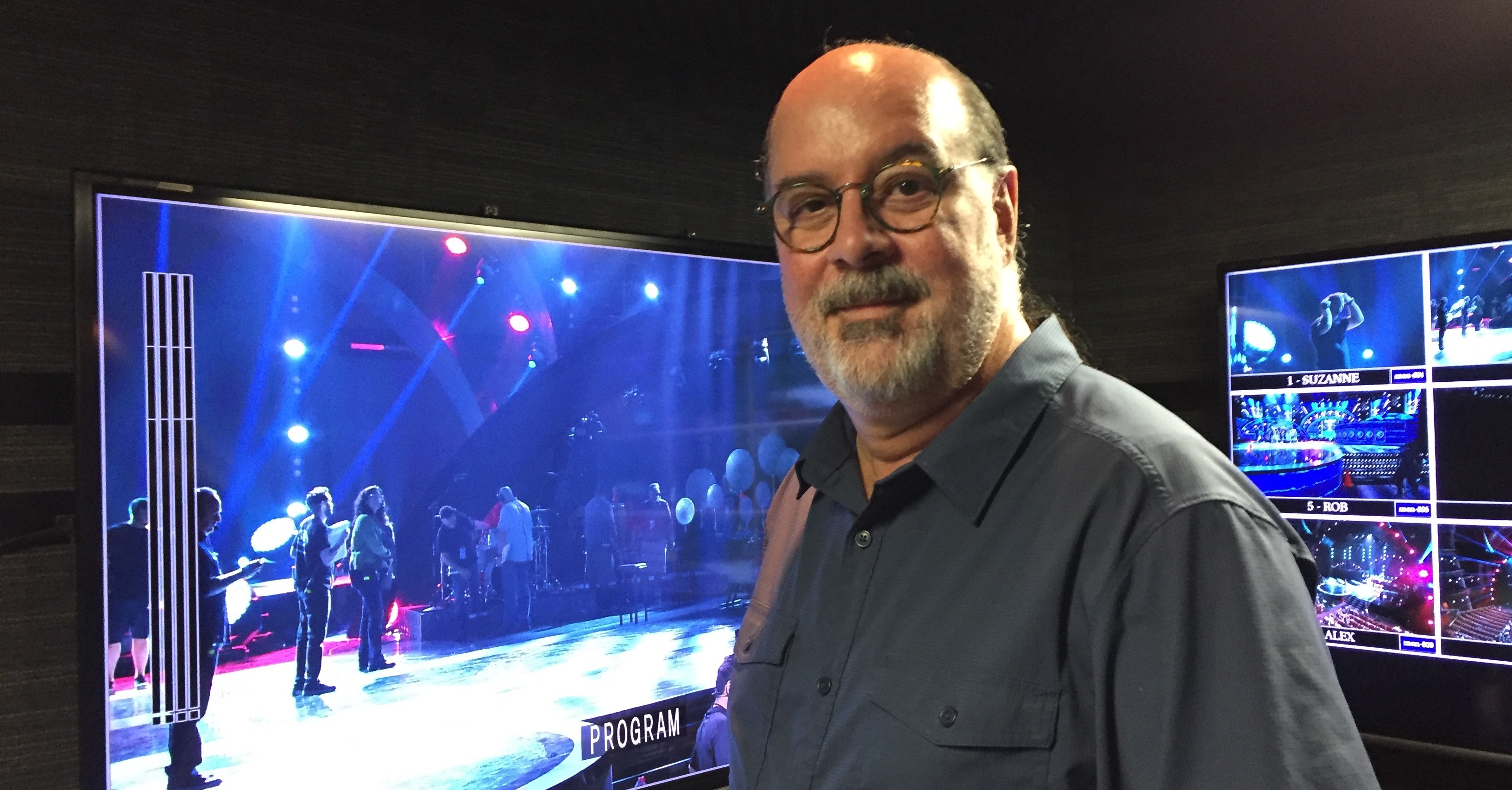
As the front of house (FOH) engineer for the GRAMMY® Awards and Latin GRAMMY® Awards for last 14 years, Ron Reaves has mixed live sound for hundreds of the most celebrated recording artists in the world. And, during the last 22 years, he has worked as both a FOH and broadcast mixer for innumerable other live and television events. Born in Ponca City, Oklahoma and settling in New Jersey, by way of Dallas, Memphis and Los Angeles, Ron never loses his excitement and gratitude for the incredible adventure his career has provided.
[MM] For a kid who dreamed of playing guitar in a rock ‘n’ roll band, how did you wind up touring with ZZ Top, Bon Jovi, Poison, Warrant, Judas Priest, Santana, Kiss and Motorhead?
[Ron] When I was in my 20s, I worked at a music store in Memphis called Strings and Things that had a big sound department and was a major player in the local music scene. One day, the head guy asked if I would like to mix sound and showed me how. I started working at small clubs and churches, found I had an aptitude for mixing and my career grew from there. Club dates turned into local festivals, and I managed to move up through the ranks.
Lots of rock bands, and people who worked with them, came through Strings and Things, and I happened to meet ML Procise, who was ZZ Top’s FOH mixer. He was a legend and one of the founders of Showco. ZZ Top had just released an album called Afterburner, and ML hired me on my first big tour as a tech in their PA crew. We were out for 18 months and traveled all over the world.
Shortly after the ZZ Top tour, I was hired on a Santana tour as an assistant to the monitor engineer. Three days into the tour, they fired the engineer and asked if I could mix monitors. Of course, I said, “Sure!” It was my first big monitor gig.
[MM] How did your rock ‘n’ roll trajectory veer into television?
[Ron] My wife wanted me around a little more. I had been touring the world for nine years when I met her. She worked in television, lived in Los Angeles and asked if I wanted to get off the road and move into television. I couldn’t wait.
She made a few introductions and soon Mikael Stewart at ATK Audiotek put his stamp of approval on me. Mikael, along with Patrick Baltzell, were principals at ATK and had nearly all the shows. I really owe Mikael a lot for launching my television career.
Then, the 1994 Northridge earthquake hit, and my wife wanted to leave California. We moved to the East Coast, but Mikael continued to refer me for jobs. The whole business is very word of mouth and, to this day, 80 percent of my work is with ATK or Firehouse.

[MM] After 14 years with the GRAMMYs, does the show still pose technical challenges?
[Ron] The biggest challenge we all face—probably in any arena—whether you are doing the GRAMMYs or a touring show, is that many of the venues we work in weren’t built for our purposes.
As opposed to some shows, where the FOH mix may not be as important, the GRAMMY audience is filled with the world’s top record producers, engineers, mastering engineers and performers. At both the GRAMMYs and Latin GRAMMYs, the FOH is of prime importance. We always take our work seriously, but, on certain shows, my job is to generate an audience response—to make people clap and dance, so it comes off well on TV. With the GRAMMYs, the Academy is very focused on how the house sounds. In fact, Leslie Ann Jones, a NARAS representative, is in charge of making sure the house sound is good and stays with me throughout the show. Leslie’s day job is running Skywalker Sound for George Lucas, so she definitely knows what she’s doing!
The Staples Center can be a challenging room, but we have four days to set up the PA system and distribute it as much as possible. We have 18 different outputs for various zones of speakers, with four main JBL VTX V25-ll line array clusters, 14 cabinets deep, aimed at the majority of the audience and three JBL VTX V20 delay clusters behind FOH to cover the rear of the venue. We also have multiple zones of JBL VRX932LAP and VT4886 small fills.
I’m a JBL guy from way back, and the thing about the GRAMMYs and other award shows is the huge variety of music we need to accommodate—from Tony Bennett to AC/DC. Even with the differences in levels, the VTX line arrays work great at every volume, with any kind of music or dialog we put through them. I know I can always rely on them.
[MM] How has the technical process at the GRAMMYs and Latin GRAMMYs changed in recent years?
[Ron] The biggest change has been the switch from analog splitters and copper wire snakes to fiber optics. It has completely changed the game. With four mix positions on the show and six consoles, we were using a lot of wire to distribute sound and that degraded the signal quite a bit. Now, everything sounds much cleaner, with a lot less buzz and hum to track down. The fidelity has probably doubled. I can run two pieces of fiber optic and land up to 250 inputs, if I need that many. I use fiber optics every day, and I am always amazed. It’s like magic to me.
[MM] With four days to prep the show, how extensive are the artist rehearsals?
[Ron] Each act gets about an hour and a half. The show is always on Sunday and rehearsals begin on Wednesday. From Wednesday to Sunday, it’s wall-to-wall, one act after another.
The funny thing about the show is that I am the only mixer who works with every single act. There are two monitor consoles, one for the A stage and one for the B stage, and the mixers go back and forth. There are also two music mixers in the broadcast truck, and they alternate. Every act comes through my console, though, so we don’t get many breaks at FOH. We do a rehearsal of an act on the A stage and, as soon as it’s done, I store that snapshot, recall the snapshot for the next band and off we go.
[MM] How long before rehearsals do you show up at the Staples Center?
[Ron] I travel to the GRAMMYs on the Monday before the show. On Tuesday morning, we have a big audio department meeting and everyone—about 50 people—sit in a dressing room, distribute all the information and I spend the rest of the day programming the show. There are usually 20 to 22 musical performances—a band every eight and a half minutes for three and half hours during the broadcast. I can’t imagine how we did the show without a digital console.
[MM] I understand you have a song you always play to make sure the PA is just how you want it.
[Ron] I do! When it comes to the GRAMMYs, I don’t get involved with the design and, in fact, I rarely design my own PA anywhere. There is always someone like Mark Dittmar from Firehouse Productions or Jeff Peterson from ATK to set it all up. I’m kind of like a racecar driver—I just show up and operate the system.
I have an old Robert Plant song, “Little By Little,” I have listened to as a reference for about 20 years now. It’s funny, but when people hear the track, they know I’m in the building. These guys do their magic, then I show up, play Robert Plant and the system inevitably sounds great!
[MM] Do artists ever bring a representative as a second pair of ears for the mixes?
[Ron] Everyone who performs brings their own mixer to act as a guide for us.
Usually, they check out the FOH mix and then go out to the TV truck, because that’s the money mix—the one several million people are going to hear. Some acts bring a FOH rep and a broadcast rep. In that case, the FOH guys and gals stay with me.
[MM] You switch between broadcast mixing and FOH. Do you prefer one to the other?
There are great things about both. There is a physicality to mixing FOH, though. Even if you are not at a screaming loud level, you’re moving a lot of air. It is definitely large. The columns are about 80 feet apart, and there is an energy you could never recreate in a broadcast truck. On the other hand, in a broadcast truck, no one ever tells me to turn up the speakers too loud. I get to decide how loud we mix. There is a lot more finesse, and you have much more control in the truck.
I always compare the two to painting a house. In the broadcast truck, we’re painting with a tiny brush. In the front of house, in an arena, we’re painting with a roller! It isn’t as precise of a process, to say the least. I enjoy going back and forth between the two and getting to work with an incredible variety of music.
There are about half a dozen mixers who do most of the major award shows and specials in America, and I feel extremely fortunate to be one of them.
Many thanks to Ron for sharing his insights on FOH and broadcast mixing! Are you a mixer who goes between the two? What’s your preference and why? Share your experience in the comments.